


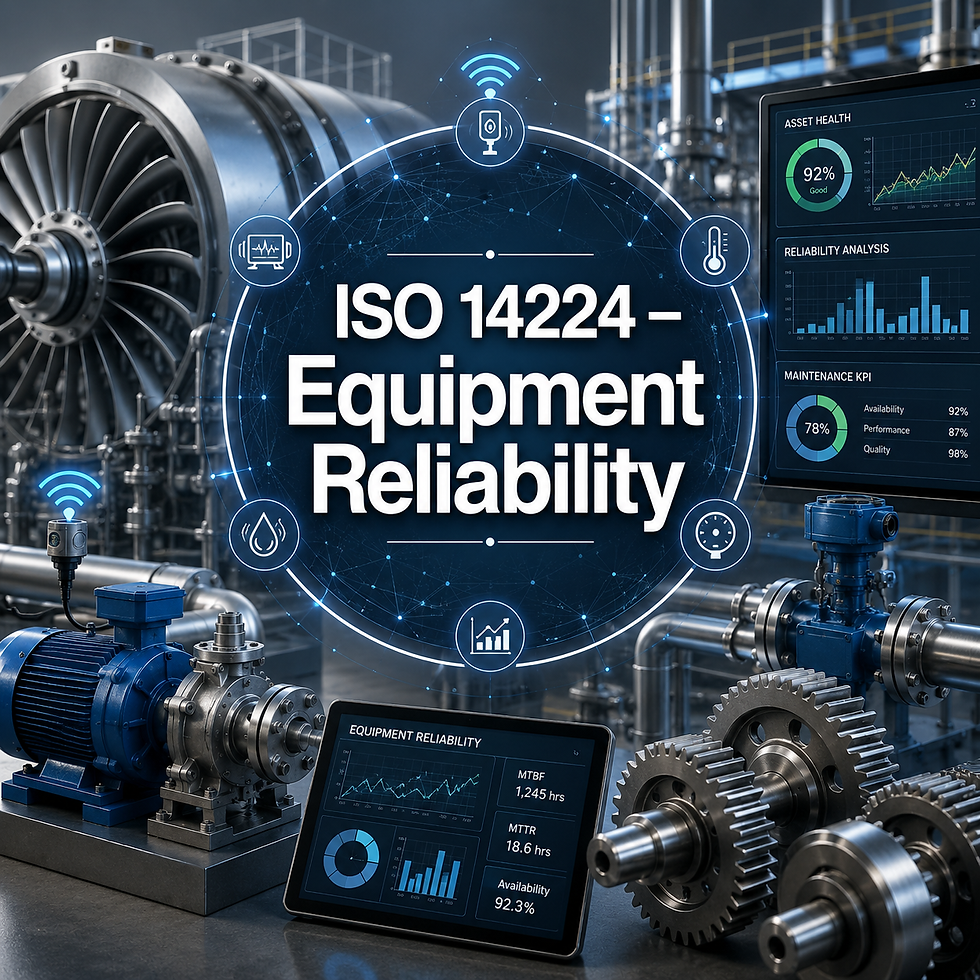
ISO 14224 – Equipment Reliability: A Practical Standard for Better Maintenance and Stronger Performance
In modern industry, equipment reliability is one of the most important factors for safe, stable, and efficient operations. When machines, systems, and technical assets work as expected, daily activities become smoother, maintenance becomes easier to plan, and teams can make better decisions.
ISO 14224 focuses on the collection and use of reliability and maintenance data for equipment. In simple words, it helps facilities understand how equipment performs, why failures happen, how often maintenance is needed, and how this information can be recorded in a clear and useful way.
This makes the standard valuable for any technical environment that wants to improve performance, reduce unexpected downtime, and build a stronger culture of quality.
What Is ISO 14224?
ISO 14224 provides a structured way to collect reliability and maintenance data during the life cycle of equipment. It gives a common method for recording important information such as equipment type, operating conditions, failure events, maintenance actions, and repair details.
The main idea is simple: good data leads to good decisions.
Without reliable data, maintenance can become reactive. Teams may only respond when something breaks. With structured data, maintenance becomes more planned, more professional, and more effective. This supports better safety, better cost control, and better use of resources.
Why Equipment Reliability Matters
Equipment reliability is not only a technical issue. It affects the whole performance of a facility. Reliable equipment helps work continue without unnecessary interruption. It also supports safety, quality, productivity, and customer confidence.
When equipment is reliable, teams can plan with more confidence. Maintenance schedules become clearer. Spare parts can be managed better. Technical staff can focus on improvement instead of emergency repairs. Over time, this creates a more stable and positive working environment.
A reliable system also helps reduce waste. Fewer breakdowns can mean less lost time, fewer damaged materials, and more efficient use of energy and resources. This makes equipment reliability an important part of responsible and sustainable operations.
The Role of Data in Maintenance
One of the strongest points of ISO 14224 is its focus on data. Many facilities collect maintenance information, but not all of them collect it in a consistent way. If data is incomplete, unclear, or different from one department to another, it becomes difficult to compare results or learn from past events.
ISO 14224 encourages a common language for reliability and maintenance. This means that teams can describe failures, repairs, and equipment conditions in a more consistent way. When everyone uses the same structure, the information becomes easier to understand and easier to use.
For example, instead of simply writing “machine problem,” the data can describe the equipment, the failure mode, the cause, the maintenance activity, and the result. This gives decision-makers a much clearer picture.
Supporting Preventive and Predictive Maintenance
ISO 14224 can support both preventive and predictive maintenance strategies.
Preventive maintenance means carrying out planned maintenance before a failure occurs. Predictive maintenance goes a step further by using data and condition monitoring to estimate when maintenance is needed.
Both approaches depend on good information. By collecting reliability and maintenance data in a structured way, facilities can identify patterns. They may notice that a certain component fails after a certain number of operating hours, or that a specific type of failure happens under certain conditions.
This information can help teams improve maintenance plans, adjust inspection intervals, and reduce the chance of unexpected failures.
Better Communication Between Teams
Technical operations often involve many different teams, including maintenance, engineering, operations, safety, procurement, and management. Each team may see equipment performance from a different angle.
ISO 14224 helps create a shared understanding. When reliability and maintenance data is collected in a standard format, communication becomes easier. Teams can discuss problems using clear terms and real evidence.
This can improve cooperation and reduce misunderstandings. It also helps management make decisions based on facts, not only assumptions.
Benefits for Quality and Continuous Improvement
A strong reliability system supports continuous improvement. When data is collected regularly and reviewed properly, facilities can see what is working well and where improvement is needed.
ISO 14224 can help identify repeated failures, high-maintenance equipment, common repair needs, and areas where training or design improvement may be useful. This creates a positive cycle: collect data, study the results, improve the process, and monitor progress.
Over time, this can lead to better maintenance performance, improved equipment availability, and stronger operational quality.
Practical Use in Daily Operations
The practical value of ISO 14224 appears in daily work. It can help teams answer important questions such as:
What equipment fails most often?
What are the most common failure causes?
How long does it usually take to repair a system?
Which maintenance actions are most effective?
Which assets need more attention?
Where can costs be reduced without lowering safety or quality?
These questions are very important for asset management. When answers are supported by reliable data, decisions become more professional and easier to justify.
A Positive Step Toward Reliability Culture
ISO 14224 is not only about forms, tables, or technical records. It is also about building a culture of reliability. This means encouraging teams to record information carefully, learn from experience, and use data to improve future performance.
A reliability culture values prevention, planning, teamwork, and long-term thinking. It helps facilities move from “fixing problems after they happen” to “understanding problems before they grow.”
This is a positive and practical approach for any facility that wants to improve quality and performance.
Conclusion
ISO 14224 offers a clear and useful approach to equipment reliability and maintenance data. It helps facilities collect the right information, use a common reliability language, improve maintenance planning, and support better decision-making.
By applying its principles, technical teams can reduce uncertainty, improve equipment availability, and create stronger maintenance systems. Most importantly, it supports a positive culture where data, quality, and continuous improvement work together.
For any facility that depends on equipment performance, ISO 14224 is a valuable guide toward safer, smarter, and more reliable operations.
Sources
Main source: ISO 14224:2016 standard description and scope. Additional public standard previews and adoption summaries.



Comments